
The Plant Engineer's Compressed Air Audit Playbook: Uncovering Leaks, Pressure Drops & Waste
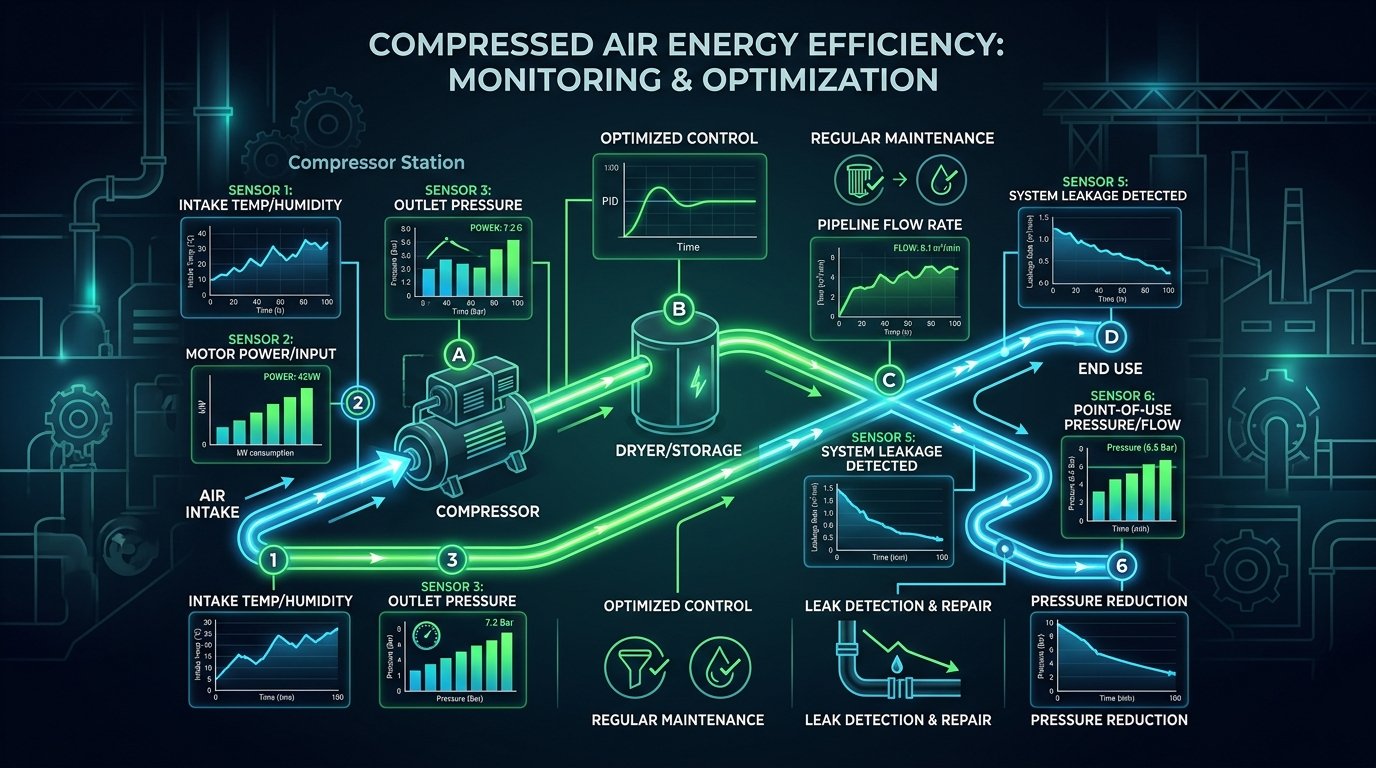
A practical, field-tested playbook for plant managers to pinpoint acoustic ultrasonic leaks, eliminate artificial line demand, and reclaim thousands of kilowatt-hours annually.
In an average industrial manufacturing facility, 20% to 30% of total compressed air generation is completely lost to distribution piping leaks. Because compressed air is invisible, non-toxic, and odorless, these leaks persist for years without detection—quietly bleeding plant cash flow every second the compressor runs.
If a plant spends $100,000 annually on compressed air electricity, an undetected 25% leak rate represents a $25,000 annual waste.
This playbook provides plant engineers and maintenance managers with a battle-tested audit methodology to quantify losses, optimize piping network architecture, and reclaim immediate bottom-line profit.

The True Financial Cost of an Air Leak
A common misconception among maintenance personnel is that small pinhole leaks are negligible. The physics of sonic orifice discharge tells a completely different story:
| Hole Diameter (mm) | CFM Loss at 7.0 Bar | kW Equivalent Waste | Estimated Annual Cost ($0.12/kWh, 8000 hrs) |
|---|---|---|---|
| 1.0 mm | 2.1 CFM | 0.35 kW | $336 |
| 2.0 mm | 8.4 CFM | 1.40 kW | $1,344 |
| 3.0 mm | 18.9 CFM | 3.15 kW | $3,024 |
| 5.0 mm | 52.5 CFM | 8.75 kW | $8,400 |
| 10.0 mm | 210.0 CFM | 35.00 kW | $33,600 |
In a typical plant with 200+ pneumatic drops, 40 small 1mm to 2mm leaks across quick-connect fittings, failed automatic drain valves, and cracked flexible hoses easily add up to $30,000+ in pure wasted electricity annually.
Ultrasonic Acoustic Leak Detection: Finding the Unseen
Human ears cannot detect air leaks above the roar of factory background noise (hydraulic pumps, conveyors, stamping presses). Professional air audits utilize ultrasonic acoustic detectors:
- Turbulent Jet Emission: When compressed air rushes through a small orifice, it generates high-frequency turbulence in the 38 kHz to 42 kHz range.
- Heterodyne Signal Conversion: Ultrasonic scanners convert these ultrasonic sound waves into audible frequencies and digital decibel ($dB$) displays on the inspector's headset.
- Directional Pinpointing: Technicians scan pipelines from up to 15 meters away, instantly locating microscopic leaks in overhead ring mains, FRL units, and pneumatic solenoid manifolds.
The Danger of "Artificial Demand"
When machine operators experience sluggish pneumatic cylinder actuation or pressure drops at the end of the line, their default reaction is almost always: "Turn up the compressor pressure from 7 bar to 8.5 bar."
This is a disastrous mistake known as Artificial Demand:
- High system pressure forces significantly more air volume through every existing leak orifice.
- High pressure increases air consumption across unregulated blow-off nozzles and tools.
- Remember the Golden Rule: Every 1.0 Bar increase in system pressure drives a 7% jump in compressor power consumption.
The proper engineering fix is never raising discharge pressure. The fix is eliminating pipeline restrictions and installing localized secondary storage receivers.
Receiver Tank Sizing: Sizing Buffer Capacitance
An improperly sized air receiver causes erratic compressor loading and chronic pressure swings.
By maintaining a properly sized Dry Air Receiver downstream of your refrigerated dryer, the buffer tank absorbs high-volume momentary demand spikes without forcing the main compressor to ramp up or cycle unproductively.
5-Step Action Checklist for Plant Managers
Implement this structured plan to eliminate compressed air waste across your facility:
- Conduct an Ultrasonic Audit During a Weekend Shutdown: Walk the plant floor with an acoustic detector when machinery is quiet. Tag every leaking fitting, regulator, and drain with high-visibility audit tags.
- Replace Timer Drains with Zero-Loss Float/Electronic Drains: Traditional solenoid timer drains cycle open even when no condensate is present, dumping 5 CFM of clean compressed air every 3 minutes. Zero-loss drains discharge only liquid.
- Upgrade to a Closed Ring-Main Header: Eliminate dead-end branch lines. A continuous circular ring-main loop balances flow from both directions, cutting piping friction pressure drops by more than 50%.
- Lower System Pressure Incrementally: Drop compressor discharge pressure by 0.2 bar per week while monitoring critical machinery. Stop when minimum required operational pressure is reached.
- Book a Certified AERODYNE Air Audit: Have our engineering team install digital power data-loggers and mass flow meters on your main header to generate a verified plant energy baseline.