
The Critical Role of High-Pressure Air in Fiber Laser Cutting: Quality, Speed & Gas Economics
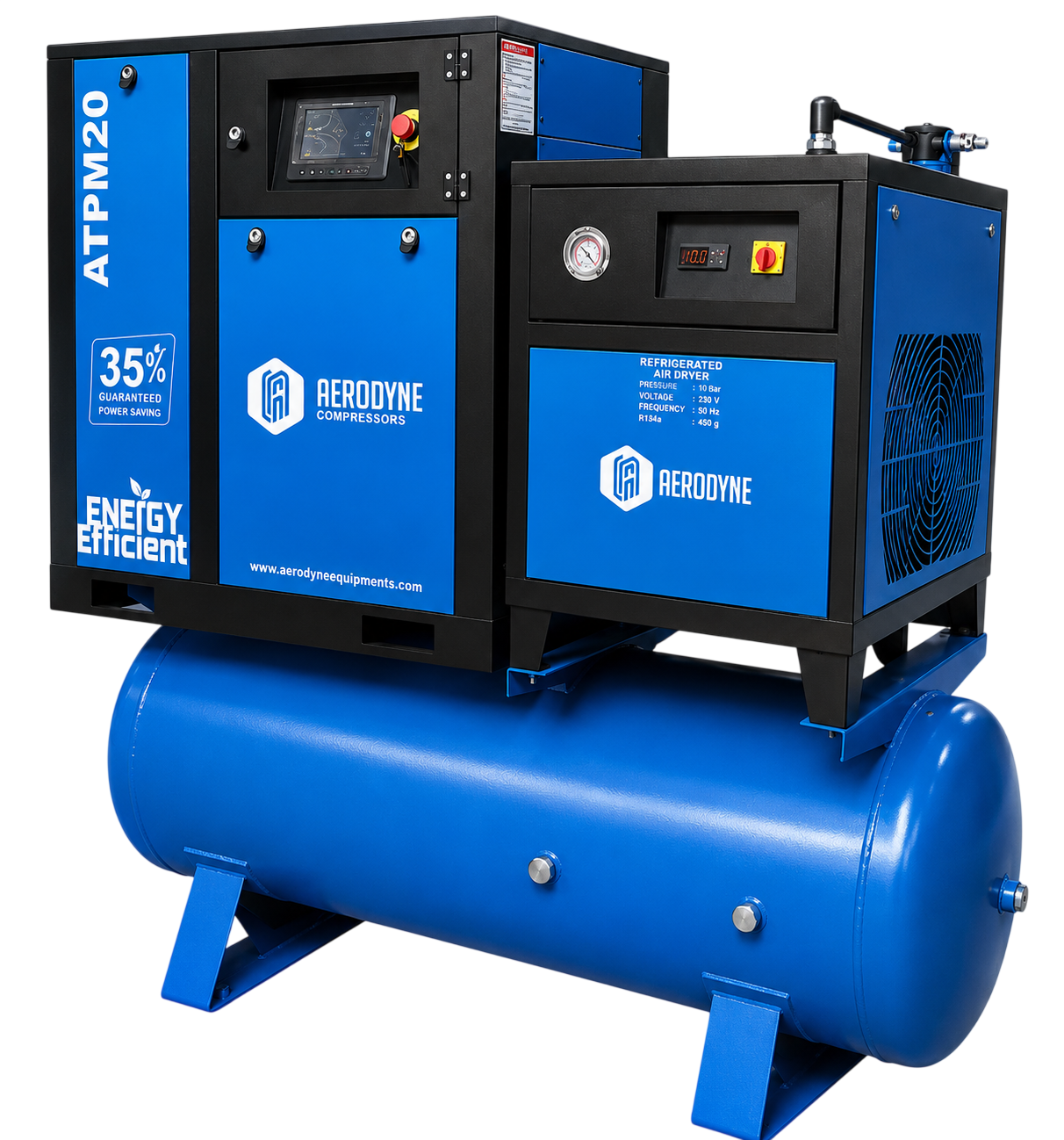
An engineering comparison between cylinder nitrogen, liquid oxygen, and dedicated 16–30 Bar high-pressure compressed air stations—cutting assist gas operating expenditure by over 70%.
In sheet metal fabrication, fiber laser cutters have evolved dramatically. Laser power sources have jumped from 3 kW and 6 kW to 12 kW, 20 kW, and beyond. However, as cutting feed speeds have multiplied, fabricators face a staggering operational headache: the exponential cost of assist gas.
Traditionally, fabricators relied exclusively on bottled or bulk liquid nitrogen (N2) to prevent edge oxidation, or oxygen (O2) for mild steel. Yet for sheet thicknesses up to 10mm–12mm in mild steel, stainless steel, and aluminum, ultra-clean 16 to 30 Bar high-pressure compressed air has emerged as the most profitable assist gas alternative in modern metalworking.
The Physics of Laser Assist Gas: Why Clean Air Works
The primary functions of assist gas at the laser cutting nozzle are:
- Kinetic Ejection: Blowing the molten slag and vaporized kerf material out through the bottom of the cut at supersonic velocity.
- Optics Protection: Shielding the laser focal lens from molten spatter and fumes.
- Edge Metallurgy: Preventing discoloration, burrs, and thermal edge dross.
While liquid nitrogen provides complete inert shielding, dry compressed air consists of 78% nitrogen by volume. When delivered at 16 to 25 Bar pressure with zero oil and zero moisture, compressed air provides immense kinetic blow-through force while maintaining acceptable edge cleanliness for subsequent welding or powder coating.
The Non-Negotiable Standard: ISO 8573-1 Class 1.2.1 Purity
Standard shop compressed air (at 7 bar) cannot be fed to a fiber laser. Any residual moisture or aerosol lubricant bypass will instantly destroy the laser protective window, burn the focusing lens, and cause laser beam scattering, costing thousands of dollars in replacement optics and machine downtime.
Laser assist air must strictly meet ISO 8573-1:2010 Quality Classes:
- Solid Particulate (Class 1): Sub-micron filtration removing particles down to 0.01 micron.
- Water Vapor / Moisture (Class 2): Pressure Dew Point (PDP) of -40°C to +3°C, ensuring absolute dryness in high-pressure delivery lines.
- Total Oil Aerosol & Vapor (Class 1): Residual oil content less than 0.01 mg/m³.
Financial Comparison: Liquid Nitrogen vs. On-Site High-Pressure Air
Let us analyze the operational numbers for a fabrication workshop running a 12 kW fiber laser for two 8-hour shifts daily (350 days/year):
| Assist Gas Metric | Bulk Liquid Nitrogen (N2) Tank | AERODYNE 4-in-1 Laser Compressor Station |
|---|---|---|
| Delivery Pressure | 20 – 25 Bar | 16 – 30 Bar (Tailored to nozzle specs) |
| Procurement Logistics | Weekly tanker refills, cryogenic cylinder rental | 100% On-site generation, zero supply dependency |
| Gas Boil-Off Loss | 1% to 3% daily evaporation loss during idle weekends | 0% Loss (Generated on-demand) |
| Monthly Operating Cost | $4,500 – $7,200 | $1,100 – $1,600 (Electrical power only) |
| Edge Finish (Mild Steel) | Clean, burr-free edge | Clean, sharp edge ready for powder coat |
| Annual Operating Spend | $68,400 per year | $16,800 per year |
Net Annual Operational Savings: $51,600 / Year
The capital cost of an AERODYNE Integrated Laser Compression Package is fully recovered in as little as 6 to 9 months.
The 4-in-1 Integrated Laser Compressor Architecture
To eliminate sprawling piping, pressure drops, and installation complexity, the AERODYNE Laser Series integrates all essential modules onto a single heavy-duty structural skid:
- High-Pressure PM-VFD Rotary Screw Air End: Heavy-duty continuous 16–30 Bar generation.
- Integrated High-Pressure Refrigerated Dryer: Pre-cools and condenses vapor out of the stream.
- Four-Stage Precision Micro-Coalescing Filtration: Progressive 3.0 μm, 1.0 μm, 0.1 μm, and 0.01 μm oil-removal elements with differential pressure gauges.
- Heavy-Duty ASME/IS-certified High-Pressure Air Receiver: Eliminates nozzle pressure drop during high-speed piercing cycles.
Conclusion: Transform Assist Gas from a Cost Center to a Competitive Advantage
Fabricators bidding on competitive sheet metal contracts cannot afford $60,000+ annual gas vendor bills. By generating ultra-clean, high-pressure assist air in-house with dedicated AERODYNE laser compression technology, metal fabricators dramatically lower cost-per-part and protect their bottom-line profitability.